German Shepherd Standard
The German Shepherd Standard was established according to the proposals of Messrs. A. Meyer and Von Stephanitz.
The registration of the German Shepherd standard is brought forward following the official decisions of the Verein für Deutsche Schäferhunde (SV), domiciled in Augsburg and affiliated to the VDH, after the first meeting of its members in Heildelberg on July 29, 1901, at the 23rd meeting of the members in Cologne on September 17, 1909, as well as at the combined session-meeting of the committee office in Wiesbaden on September 5, 1930 and at the session of the Breeding Commission and the SV Committee on March 25, 1961.
The German Shepherd Dog Standard established in 1899 after the founding of the SV has undergone Variations in central and southern Germany, where there are many dogs of this breed: the ultimate goal has been to breed useful dogs that could participate in tough tests and great feats.
To achieve this purpose, the Standard has been set in such a way that both the physical qualities and psychological characteristics of the German Shepherd can be met.
General Appearance and Character (German Shepherd Standard)
The German Shepherd is a medium-sized dog. The height is the distance from the ground to the withers with the hair flattened, following a vertical line that passes just past the elbow. The ideal height is 62.5 cm for males and 57.5 cm for females.
An oscillation of 2.5 cm too much or too little is allowed, so the height for males can be set at 60 to 65 cm and for females at 55 to 60 cm.
Dogs that exceed the maximum height or do not reach the minimum are considered of lower value in terms of their usefulness and breeding.
The German Shepherd is slightly long, and strong and muscular. Its skeleton is dry and its structure is firm. The relationship between the height and length of the limbs (angulations), as well as their location and position, must ensure a wide and firm trot.
Their fur should protect them from the elements.
It is necessary to make an effort to give it a beautiful and pleasant presentation, but never diminish its working capabilities.
Sexual dimorphism
The sexual characteristics have been very pronounced, that is, both the masculinity of the male and the femininity of the female must be evident.
The German Shepherd Dog that corresponds to the type of the breed must give an image of strength and robustness, as well as intelligence, with a lively and alert look that suggests its alertness. He must be agile and light, and move, move, look and carry himself with ease and subtlety. Likewise, he must manifest and behave quickly and lightly, because if there are healthy nerves in a healthy body, both things together ensure great toughness and service.
Despite having a temperament overflowing with vitality, he must be obedient, be able to adapt to each situation and carry out his mission with joy and docility. It is necessary that he can show courage and temperament when it comes to defending his master or his property. He must attack happily when his master wishes, he must be a vigilant companion, but obedient and pleasant, especially with children and other animals, and indifferent towards other people. He must, in a word, give a harmonious image of a natural (innate) nobility, which evidences total self-confidence.
Angulation and movement
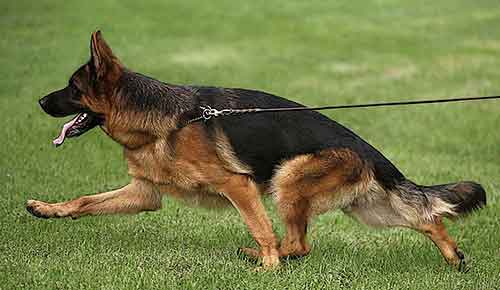
The German Shepherd dog is a trotter. For this reason, his limbs, when walking, move diagonally; That is, it moves the left forelimb at the same time as the right hindlimb.
The limbs must be angled in such a way that, apparently, without significantly changing the line of the back, the hind legs advance to the middle of the body, taking them to the precise place, as stretched as possible and the front quarters allow.
A fair proportion between the height and length of the body and a harmonious length of the limbs ensure a wide stride that gives the impression of requiring no effort in the progression: the legs move level with the ground, the head is horizontal, the tail remains slightly raised, the shape is uniform, regular and calm, and the dorsal line, straight, firm and elastic, runs from the tip of the ears through the nape and back to the end of the tail, that is, forms a well-drawn and continuous line.
Head (German Shepherd Standard)
The head should be proportionate to the size of the dog, without being heavy or coarse, with a dry general appearance, moderately wide between the ears.
Front: Seen from the front and from the side, the front should only be slightly domed, with the central groove slightly or not at all pronounced.
Zygomatic arches: They are slightly rounded, without being prominent.
Skull: The upper line of the skull decreases slightly from the ears towards the muzzle, which seen in profile is strong, inclined, finished, wedge-shaped and dry. Craniofacial or stop angle that is not very marked and located approximately in the middle of the head.
Muzzle or face: Strong, lips tight and dry, and close well.
Teeth
In the German Shepherd Standard, the teeth must be powerful, healthy and complete (42 teeth, 20 in the upper jaw and 22 in the lower jaw). The denture closes in the shape of scissors, that is, the upper incisors must adapt like scissors over the lower ones. Upper and lower prognathism are imperfections, as are wide spaces between teeth. The teeth must be correctly positioned. The jaws must be strongly developed to allow good fixation of the teeth.
Ears
Standard ears are medium in size, wide at the base and set high. They must be carried straight and forward. They end in a sharp point. Broken, cut or drooping ears are rejected. Collie-type ears significantly spoil the image of the breed. It is preferable to breed only dogs with straight ears.
Puppies and young dogs have their ears hanging down up to six months of age, and sometimes even longer.
When running or in a prolonged rest position, many dogs lower their ears. This is not considered a defect.
Eyes
Medium in size, almond-shaped, they are located a little obliquely; They should not be bouncy.
The color of the eyes depends on the color of the dog's coat; They always tend to be very dark. They must have a lively and intelligent expression, but defiant when facing a stranger.
Neck
Its appearance should be strong, with well-developed muscles. The skin on the neck should not have a lax jowl. The dog carries its neck at approximately a 45º angle with respect to the horizontal, raising it when excited and lowering it when running at a trot.
Stem
The length of the body must be greater than the height of the withers. This proportion for the German Shepherd standard should be between 110 and 117% more length in relation to height. Short-bodied, square-looking dogs that are too tall should be eliminated.
Chest: The chest is deep (around 45 to 48% of the size) but not excessively wide. The lower line of the chest should be as long and marked as possible.
Ribs: Long and well shaped, neither barrel-shaped nor very flat, they extend to the sternum, which is at the height of the elbows. A well-built thorax allows free movement of the elbows when the dog begins to trot. If it is rounded, it causes disturbances to the standard of the German Shepherd and a rotary movement of the elbows, and if it is narrow, it causes elbows that are drawn in and lack poise.
The thorax: extends quite far back, making the flanks relatively short
Belly: Moderately gathered.
Back: It includes the kidneys and is straight and strongly developed. It should not be very long between the withers and the rump or haunch.
Withers: Long and quite high, it is well drawn with respect to the back, but without interrupting the dorsal line that goes from front to back.
Flanks: Wide, strong and muscular.
Croup: It should be long and slightly drooping (around 33%). The innominate (pelvic girdle and ileum) is the base of the bone. A short, drooping or upright croup is undesirable.
Cola
With thick, thick hair, it should reach at least as far as the hock, without exceeding the middle of the metatarsus. Sometimes the end of the tail forms a side hook that is undesirable for the German Shepherd standard. When the dog is calm, the tail should form a gentle curve. When excited, the curve is accentuated and the tail straightens, but without exceeding the vertical. It should not be carried horizontally or lying on its back.
Previous members
Back: Long and located obliquely with an inclination of about 45º, it should not be directed forward. The arm is articulated at a right angle in relation to the back. Like the back, both limbs must be strong and well muscled.
Forearms: They should be straight when viewed from any side. The bone is more oval than round.
Pasterns: Firm, neither too straight nor too drooping, with an approximate inclination of 20º.
Elbows: They should neither be close to the chest nor detached from it.
Hindquarters
Thighs: Wide and very muscular. Seen from the side, they are located obliquely at an angle of approximately 120º, to utilitarianly correspond to the angulation of the leg. Both have a harmonious length.
Tarsus: Strong and firm.
Metatarsus: Powerful and strong.
The hind limb must be powerful and muscular as a whole in order to provide a thrust capable of propelling the dog effortlessly when running.
Paws
Round, short, firm and arched.
Octopus: Very hard.
Nails: Short and strong, dark in color.
Dewclaws: They are sometimes found on the hind limbs. They must be removed shortly after birth, as they can cause separation of the hind limbs during walking, as well as injuries during jogging or working.
Color
With shades and intermediate tones called variously, these are the accepted colors within the breed standard.
Color variations are accepted in the German Shepherd Standard. Black, iron gray and ash gray, red and faded tan, unicolor or with regular spots ranging from tan red, yellow and light gray (black with gray or tan spots; tan and red or light brown with light spots). Small white spots on the chest and legs may be acceptable but are not desirable. For all colors, the nose must be black. (Dogs with little or no mask, with yellowish or clear eyes and whitish nails are considered to be lacking in pigmentation.)
The undercoat is often lightly colored, except in black dogs, where it has a slightly gray coloration.
The final color of the pups cannot be determined until the covering hair appears.
Fur
a) Short, straight hair (called stockhaaring).
The covering hair is compact, thick, dense and hard. The hairs must be straight and firm. It has to be short on the head, inside the ears, on the inside of the limbs, legs and fingers, and longer on the neck, where it is strongest. On the back of the forelimbs and hindlimbs, the hair is a little longer up to the wrist and to the hamstring. On the thighs, the fur forms a breeches whose hair is of moderate length. The length of the hair differs and varies depending on the specimen. Very short or fox-like hair is a defect.
b) Long hard hair (called langsdockhaaring).
The cover hair is longer, is not always straight and does not adhere closely to the body, particularly at the base of and behind the ears, on the back of the forearms and in the region of the kidneys. The hairs are considerably longer and sometimes form a bunch or crest and fringes from the elbows to the pasterns.
The thigh breeches have long, thick hair. The tail is thick and scalloped. This coat is not desirable since it does not protect against the weather like the previous one, but these individuals are nevertheless admitted for breeding if the undercoat is sufficiently thick.
c) Long hair (called langhaaring).
It is considerably longer than the previous one. It is the hair that is often divided in a line above the back. The undercoat occurs only in the kidney region and is generally absent. Long-haired specimens often have a narrow chest and a long, narrow snout.
Long-haired dogs are not desirable for breeding, since their coat does not protect against the elements and decreases their ability to work.
Flaws (German Shepherd Standard)
All imperfections that reduce the capacity for work, resistance and performance are considered as such, and above all an appearance that does not show sex and a nature that does not correspond to the temperament of the German Shepherd.
Defects include indifference, nervous weakness or overexcitement, fear, and lack of vitality and joy at work. In addition. Monorchid or cryptorchid specimens are imperfect, as well as those with very small testicles. A lymphatic and heavy constitution, lackluster colors and strong depigmentation are also defects.
These defects imply the exclusion of the dog from selection tests and exhibitions. The same happens with albino dogs with a complete lack of pigmentation (with a brown-pink or red nose) and with unicolor white dogs (even if they have a black nose).
Dogs that exceed or do not reach the accepted size, weak specimens, those that are very tall or very short on legs, those that are very light or heavy, those that have too straight limbs; loose back; faults that reduce the firmness and amplitude of the gait; the snout is very short or whose exaggerated elongation at the tip denotes weakness; jaw defects, especially teeth that do not fit together, weak or deteriorated dentures, and upper or lower prognathism.


Comentarios
Publicar un comentario